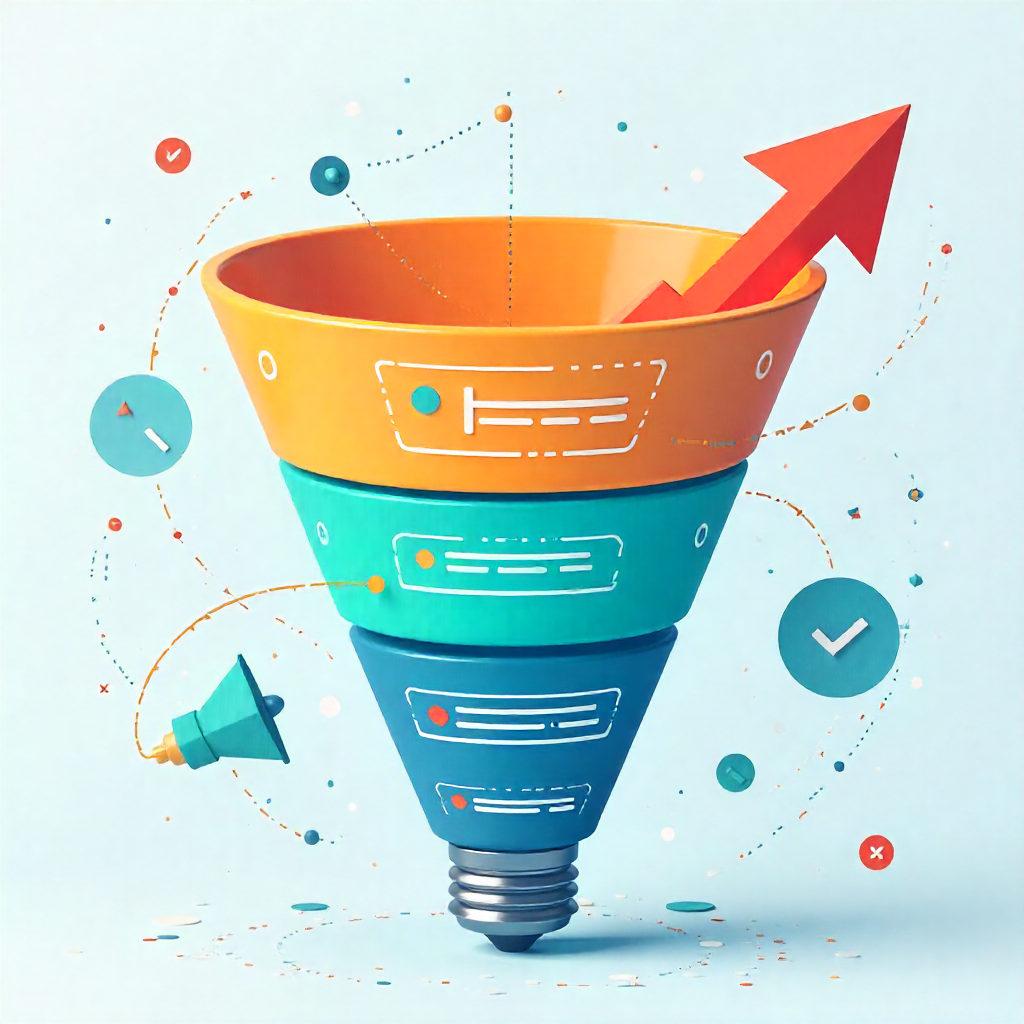
The marketing funnel isn’t dead — it’s just smarter. In 2025, brands aren’t chasing random clicks or vanity metrics. They’re architecting data-driven full-funnel systems that move users seamlessly from awareness to conversion to advocacy — with AI, automation, and intent signals doing the heavy lifting.
Here’s how to build a high-performance full-funnel strategy that drives real ROI in 2025.
1. Map the Funnel Around Intent, Not Just Stages
The old linear funnel — Awareness → Consideration → Conversion — doesn’t reflect how customers actually buy anymore.
Today’s users bounce between platforms, research online, talk to peers, and re-engage via retargeting.
That’s why intent-based funnel mapping matters. Instead of defining stages by content type (“blog,” “ad,” “email”), define them by intent:
- Problem-aware → They’re identifying a pain point.
- Solution-aware → They’re exploring options.
- Product-aware → They’re comparing you to competitors.
- Action-ready → They’re ready to convert.
Every touchpoint should be mapped to an intent — not just a stage.
2. Awareness: Build Demand, Not Just Reach
2025 awareness isn’t about impressions. It’s about attention that converts later.
Use short-form video, podcasts, and native ads that educate or entertain while subtly introducing your value proposition.
For example, an Indian fintech could run influencer-led explainer reels about “How to invest ₹500/month” — building brand recall without a hard sell.
AI helps here too — platforms like Meta Advantage+ or YouTube Ads use audience signals to find “lookalikes” most likely to become converters later in the funnel.
3. Consideration: Educate and Nurture with Data
At this stage, your audience knows their problem — now they’re evaluating solutions.
Deploy personalized content powered by automation tools like HubSpot, MoEngage, or WebEngage:
- Case studies tailored by industry or region
- Interactive calculators (ROI, pricing estimators)
- Email drips triggered by engagement behavior
In India and APAC, WhatsApp automation has become a key mid-funnel channel — blending education with conversational touchpoints.
Data from your CRM and pixel tracking can help you score leads by intent level — ensuring sales only touches the hottest ones.
4. Conversion: Simplify and Speed Up the Decision
When buyers are ready, complexity kills conversions.
Your website, landing pages, and checkout flows should be optimized for speed, clarity, and trust:
- 3-click checkout or lead submission
- Instant offers visible above the fold
- Localized payment or demo options
AI-driven CRO (conversion rate optimization) tools like VWO or Optimizely can auto-test layouts, CTAs, and copy variations to improve outcomes.
And don’t forget remarketing — retargeting users with urgency-based messaging (“limited-time bonus” or “free setup today”) still drives a measurable lift in ROI.
5. Retention and Advocacy: The New Growth Engine
In 2025, retention is the new acquisition.
Your bottom funnel doesn’t end at purchase — it expands into loyalty loops.
Use AI-led lifecycle marketing to predict churn, upsell opportunities, or renewal triggers.
Example:
A SaaS company can use predictive analytics to identify users showing drop-off signals (reduced logins, lower usage) and proactively offer personalized check-ins or add-on discounts.
Turn happy users into advocates through referral programs, testimonials, or UGC (user-generated content). In India, especially, word-of-mouth amplification via social proof is gold.
6. Integrate Measurement Across the Funnel
A true full-funnel strategy needs unified measurement.
Use tools like Google Analytics 4, Mixpanel, or Adjust to connect top-funnel awareness metrics with bottom-funnel conversions.
Track not just “what” converts, but “how” users move across touchpoints.
Attribution models (especially data-driven ones) now help marketers assign value accurately — so your budget flows to what truly works.
7. The Tech Stack That Powers It All
A 2025-ready full-funnel engine blends:
- AI Ad Platforms: Meta Advantage+, Google Performance Max, Amazon DSP
- Automation & CRM: HubSpot, Salesforce, MoEngage
- Analytics & Attribution: GA4, Mixpanel, AppsFlyer
- Creative Optimization: Jasper, Canva, Smartly.io
The winning formula?
Automation for scale. Data for precision. Human creativity for differentiation.
The Takeaway: Funnels Don’t Sell. Systems Do.
A full-funnel strategy in 2025 isn’t a campaign — it’s a system.
Every channel, creative, and message feeds into a single purpose: moving intent closer to action.
Marketers who connect their tech stack, data, and storytelling will dominate.
Those who don’t? They’ll keep wondering why their ads “almost worked.”