Most new digital campaigns don’t fail because the strategy was wrong. They fail because teams start judging performance before the campaign has earned the right to be judged.
In the first few weeks, dashboards get crowded, weekly numbers start circulating, and pressure builds to either scale or stop. Decisions get made—but not always for the right reasons. The real issue isn’t access to data. It’s knowing which signals matter now versus which only matter later.
A new campaign needs metrics that help you think clearly, not ones that simply look impressive in a report.
Metrics That Confirm the Campaign Is Working as Intended
Before asking whether a campaign is profitable, you need to know whether it is even set up correctly.
1. Reach and Impressions
Reach and impressions are not success metrics. They are diagnostic metrics.
Early reach tells you whether platforms can deliver your ads to the intended audience at scale. If reach is lower than expected, the problem is usually structural—targeting that’s too narrow, bids that are too constrained, or creative that fails platform checks.
High reach on its own is not a win. However, unexpected reach patterns are an early warning system. Many teams ignore this and move straight to optimisation, fixing symptoms instead of causes.
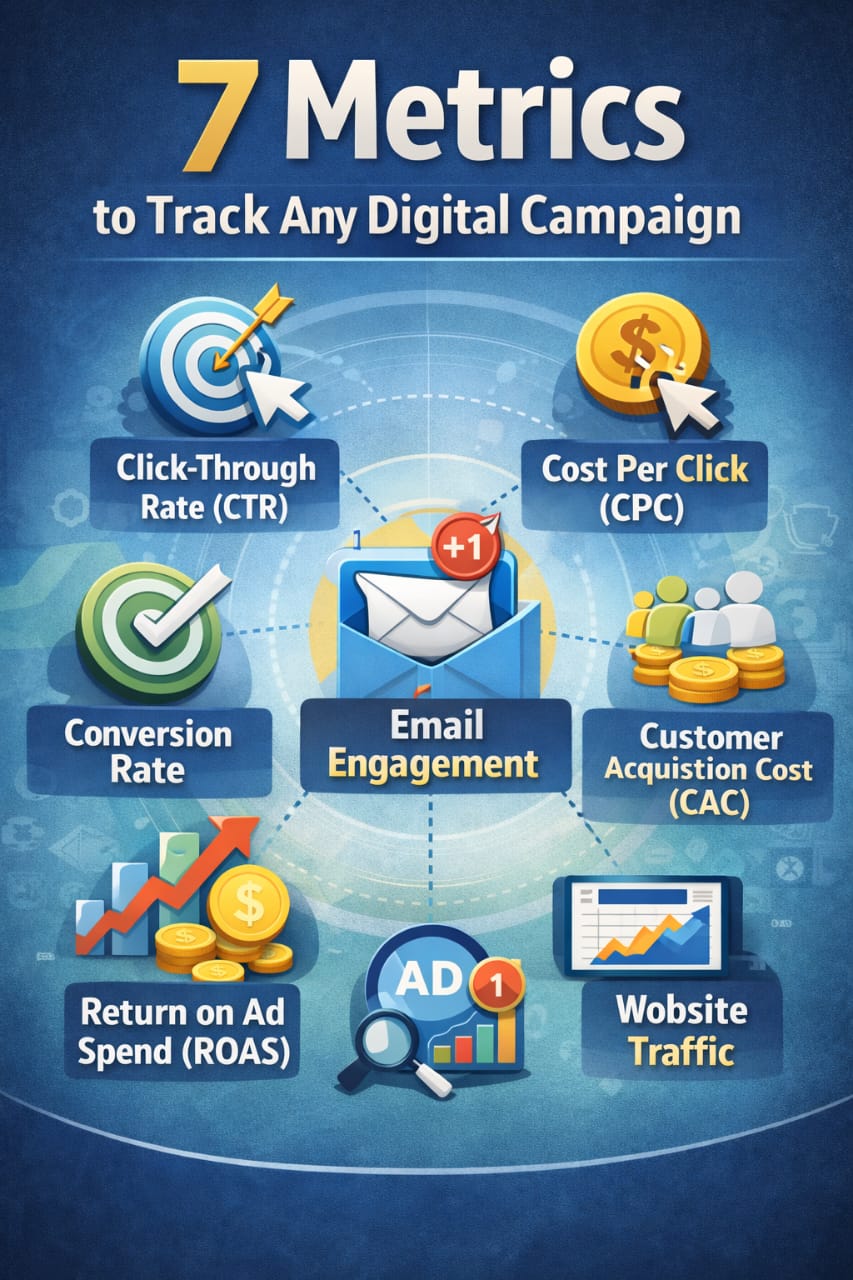
2. Click-Through Rate (CTR)
CTR is one of the few early metrics that reliably signals something useful. It shows whether your message resonates with the audience you’re reaching.
When CTR is weak, the issue is rarely the landing page. It’s almost always the framing of the offer, the clarity of the message, or the relevance of the promise. Comparing CTR to industry benchmarks is less useful than comparing variations within the same campaign.
At this stage, the goal is learning—not validation.
Metrics That Reveal Whether Traffic Has Intent
Once people start clicking, the question shifts from how many to who.
3. Cost Per Click (CPC)
CPC is often misunderstood. Lower is not automatically better.
In competitive categories, cheap clicks usually come from users with limited intent. Slightly higher CPCs can signal stronger relevance and better downstream behaviour. What matters most is consistency.
Sudden drops in CPC without improvement elsewhere often indicate declining traffic quality. Treat CPC as a context metric, not a performance target.
4. On-Page Behaviour
Basic engagement signals—such as time spent on page, scroll depth, or interaction with key elements—show whether visitors understand what they landed on.
If users leave quickly, the problem is often misalignment between the ad and the page, not the page quality itself. Teams frequently redesign pages when they should be tightening the message upstream.
Engagement metrics help identify this mismatch early.
Metrics That Tie Marketing to Commercial Outcomes
Only after delivery and intent are validated does it make sense to judge performance in business terms.
5. Conversion Rate (Including Early Signals)
Focusing only on final conversions hides where interest actually drops.
Early actions—form starts, partial submissions, or key clicks—signal intent even when final conversion takes time. A strong early funnel with weak completion usually points to trust issues, pricing friction, or complexity later in the process.
Shutting down campaigns at this stage often means discarding valuable learning.
6. Cost Per Acquisition (CPA)
CPA matters—but timing matters more.
Early CPAs are naturally volatile. What decision-makers should focus on is direction, not precision. Is CPA improving as data accumulates, or is it unstable and inconsistent?
A campaign that learns steadily is very different from one that never stabilises. Treating both the same leads to premature decisions.
7. Lead or Revenue Quality Signals
In many businesses, revenue doesn’t appear immediately.
Instead of forcing early ROI calculations, track signals that indicate future value—qualified leads, follow-up rates, sales progression, or movement to the next funnel stage. These metrics connect marketing activity to real business outcomes without distorting expectations in the early phase.
What Decision-Makers Should Do Differently
The most important shift is mental. Early campaigns are about understanding, not efficiency.
Expecting immediate performance pushes teams to optimise too early and learn too little. Metrics should be reviewed in groups, not isolation. A strong CTR with weak engagement tells a very different story than weak CTR with strong on-page behaviour.
Finally, fewer metrics discussed seriously will always outperform long reports that nobody truly reads.
Conclusion
Metrics are not there to justify spend or defend decisions. They exist to reduce uncertainty.
When the right signals are tracked at the right stage, new campaigns stop feeling unpredictable. They become systems you can assess calmly, adjust deliberately, and scale with confidence—or shut down early for the right reasons.