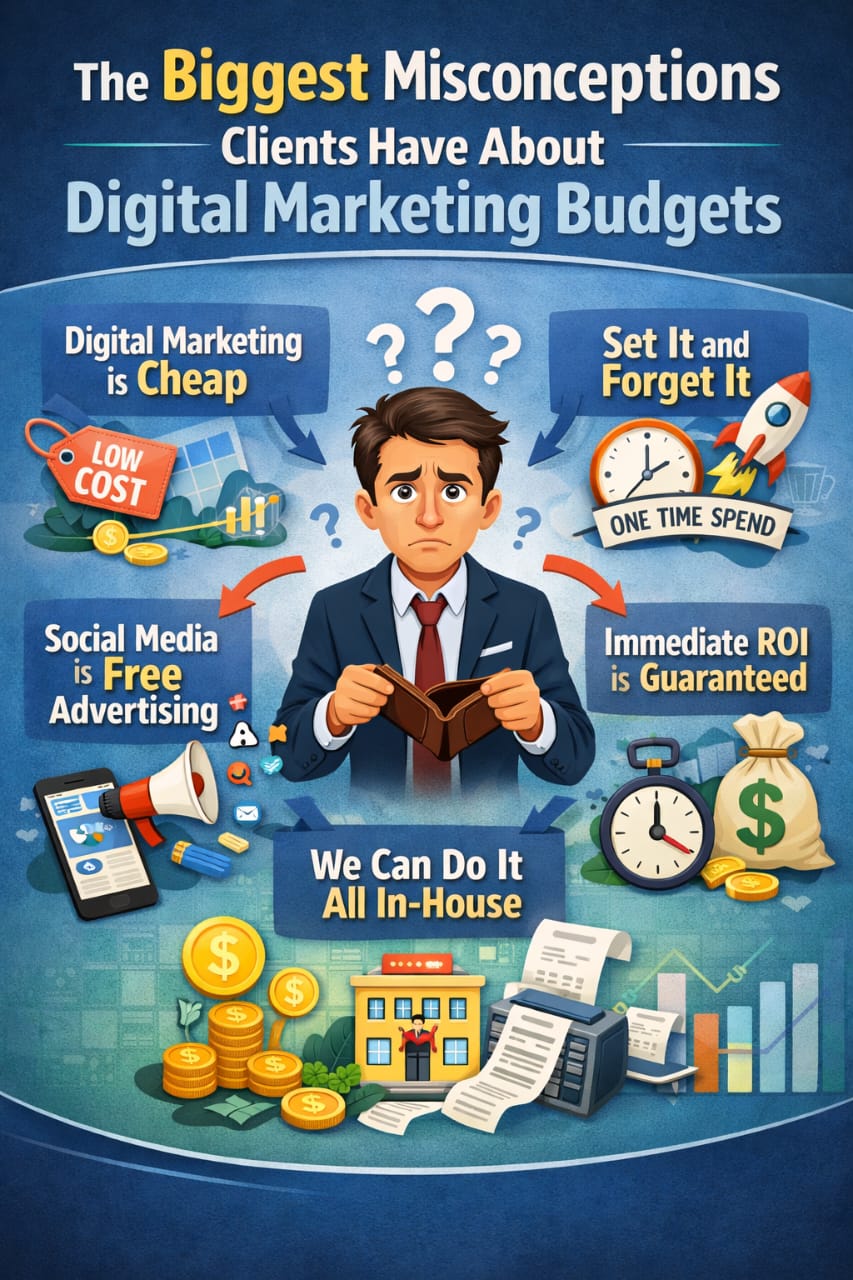
Most digital marketing budgets don’t fail because they’re too small.
They fail because they’re built on the wrong belief.
Many founders and leadership teams treat the marketing budget as the price of being present online—a necessary monthly expense to keep ads running, content publishing, and dashboards updating. But that mindset is exactly where things start to break.
A digital marketing budget is not an operating cost. It is a commercial decision. It defines how growth will be created, where demand will come from, and how efficiently the business can convert attention into revenue.
When budgets are treated like routine expenses instead of growth mechanisms, even generous spends struggle to move the business forward.
The real problem isn’t how much money is being spent.
It’s what the business expects that money to actually achieve.
Misconception #1: Budgets Exist for Platforms, Not Outcomes
One of the most common mistakes is allocating budgets by platform instead of purpose.
A fixed amount for Google Ads. Another for Meta. Something for SEO. A small slice for LinkedIn. On paper, it looks organised. In reality, it lacks intent. There’s often no clear definition of what each allocation is supposed to change in the business.
This leads to activity without direction.
When budgets are channel-led, success gets measured through surface metrics—impressions, clicks, cost per lead. These numbers can look encouraging while revenue quality, pipeline movement, or acquisition efficiency barely improve.
Marketing looks busy, but growth feels stuck.
Budgets should start with the business problem, not the media mix. Is the priority demand creation? Faster pipeline movement? Entering a new market? Reducing acquisition costs without killing volume?
Platforms are execution tools. They are not strategy. When money follows outcomes instead of channels, optimisation becomes meaningful rather than cosmetic.
Misconception #2: Spending More Fixes Weak Fundamentals
There’s a quiet assumption in many teams that poor performance can be solved by increasing spend. In practice, budget doesn’t fix problems—it exposes them faster.
If positioning is unclear, targeting is broad, or the offer doesn’t resonate, higher spend simply accelerates inefficiency. More traffic hits the same weak message. More leads enter the same leaky funnel.
Digital marketing is brutally honest. Clear messaging, a well-defined ideal customer, and a strong value proposition decide whether money works hard or disappears quietly.
This is why some brands scale profitably with controlled spends while others struggle despite aggressive investment. The budget didn’t fail. The thinking behind it did.
Money should follow clarity—not attempt to manufacture it.
Misconception #3: Budgets Should Be Fixed and Predictable
Many organisations lock digital marketing budgets into neat monthly figures tied to reporting cycles. It feels safe. It’s also disconnected from how performance marketing actually works.
Audiences shift. Creatives wear out. Competition changes bids overnight. Market conditions move faster than static plans allow.
High-performing teams treat budgets as flexible capital, not fixed costs. One portion of spend is expected to produce consistent results. Another is reserved for testing, iteration, and learning.
This isn’t waste—it’s how relevance is maintained.
When leadership expects certainty from every rupee spent, teams stop experimenting. Campaigns become repetitive. Performance declines. Marketing gets blamed.
The issue isn’t capability. It’s the refusal to let the budget adapt to reality.
Misconception #4: Short-Term Efficiency Equals Long-Term Success
Short-term metrics are comforting. Low acquisition costs. High click-through rates. Immediate returns. They give a sense of control.
But these numbers often reflect existing demand—not future growth.
In industries like B2B, SaaS, real estate, fintech, and premium services, decisions aren’t impulsive. Buyers take time. Trust matters. Familiarity matters.
Brands that only fund immediate conversion eventually compete on price and frequency instead of credibility.
Sustainable digital marketing budgets support both demand capture and brand development. Not every impact shows up in a weekly report, but that doesn’t make it irrelevant.
Long-term performance is built through consistency, memory, and perceived authority—not just efficiency.
What Decision-Makers Should Do Instead
The first shift is simple: stop asking whether the budget is enough and start asking whether it’s structured correctly. A smaller, well-aligned budget will outperform a larger, poorly designed one almost every time.
Second, budgets should be grounded in business realities, not marketing tools. Sales capacity, market maturity, competitive intensity, and revenue goals should guide allocation decisions.
Third, separate learning spend from scaling spend. Early budgets exist to reveal what works. Later budgets exist to amplify proven signals. Mixing the two leads to frustration and poor judgment.
Finally, measure performance over realistic timelines. Digital marketing rewards discipline and clarity far more than constant, reactive optimisation.
Closing Thought
Digital marketing budgets fail when they’re treated as costs to control rather than systems to design.
The advantage isn’t spending more.
It’s spending with intent, clarity, and commercial awareness.
When budgets are aligned with how businesses actually grow, results stop feeling random—and start becoming repeatable.